EY Wavespace: Customer experience training at scale
Four modules of hands-on CX skill-building that reached four cohorts worldwide, with NPS scores rated world-class.

The context
EY Wavespace is the firm's global network of innovation centers, where teams collaborate with clients to prototype solutions and tackle complex challenges. The spaces are designed to spark bold thinking, but even the most forward-looking environments need sharp human skills to match the ambition.
The opportunity
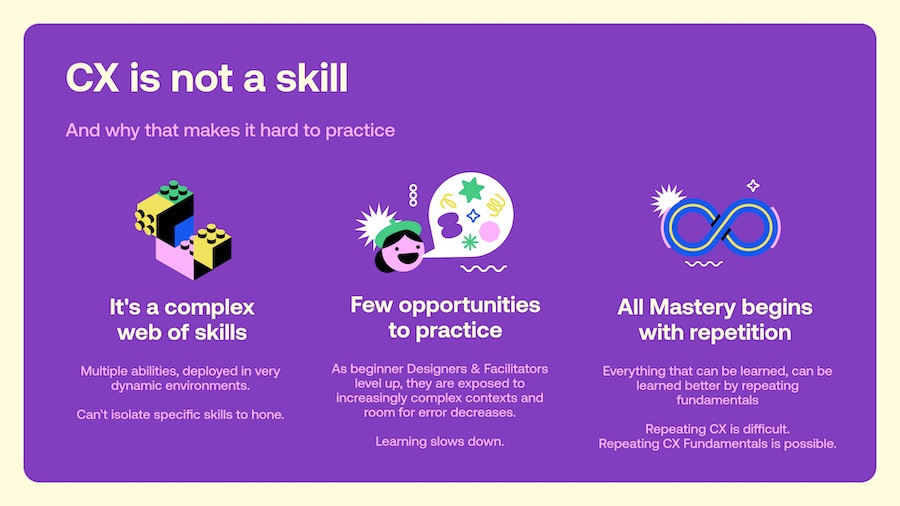
The Wavespace team wanted to elevate CX capability across their global network. Not through more frameworks or theory, but through practice. The gap wasn't knowledge. It was the ability to actually do client-centric work under pressure: reading rooms, building trust with diverse stakeholders, designing experiences that land, and telling stories that don't lose the room.
What we built together
A four-module program where 75% of each session was hands-on. No lengthy slide decksc about CX principles. Just scenarios, drills, and real work participants could use the next day.
The design challenge
The brief sounded simple: build CX capability across a global team. But the real challenge was harder. How do you teach something as instinctive as reading a room? How do you scale an experiential program across time zones without losing what makes it work? And how do you make senior professionals practice skills they think they already have?
We ran a multi-week sprint with Wavespace leaders, digging past the official brief to surface the real needs underneath. What emerged: skill gaps that couldn't be solved with more frameworks, a need to link creative work more closely to business outcomes, and pain points that required practice rather than theory.
Game design meets learning design
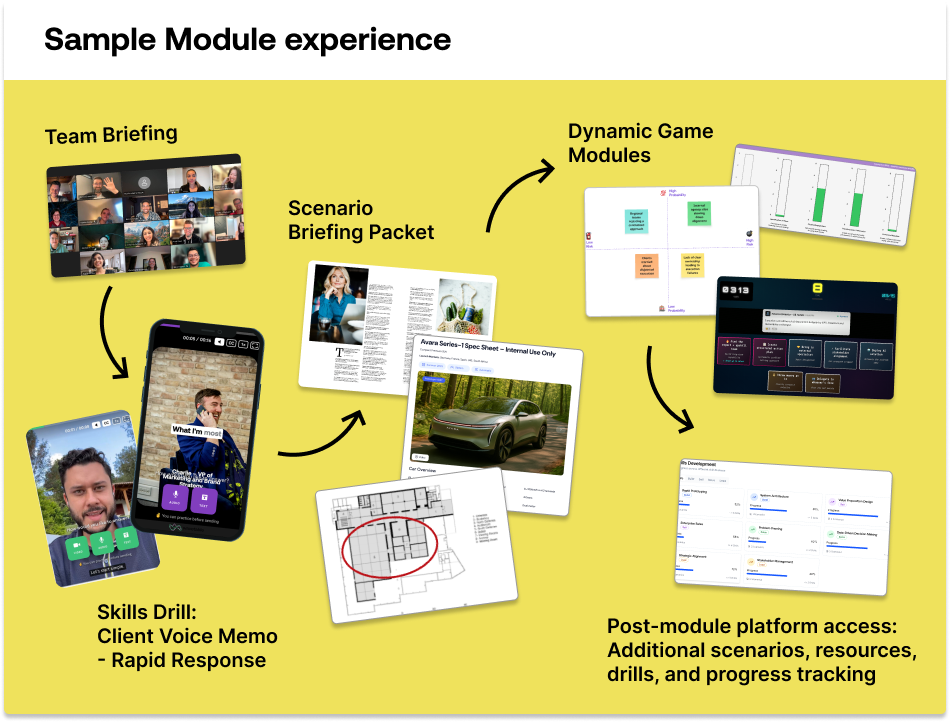
We used our SDS approach, but the real innovation was in the mechanics. Each module combined:
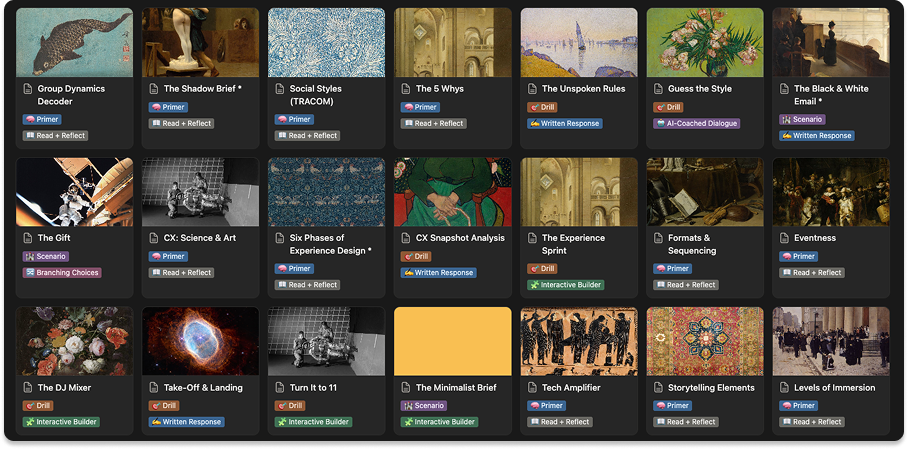
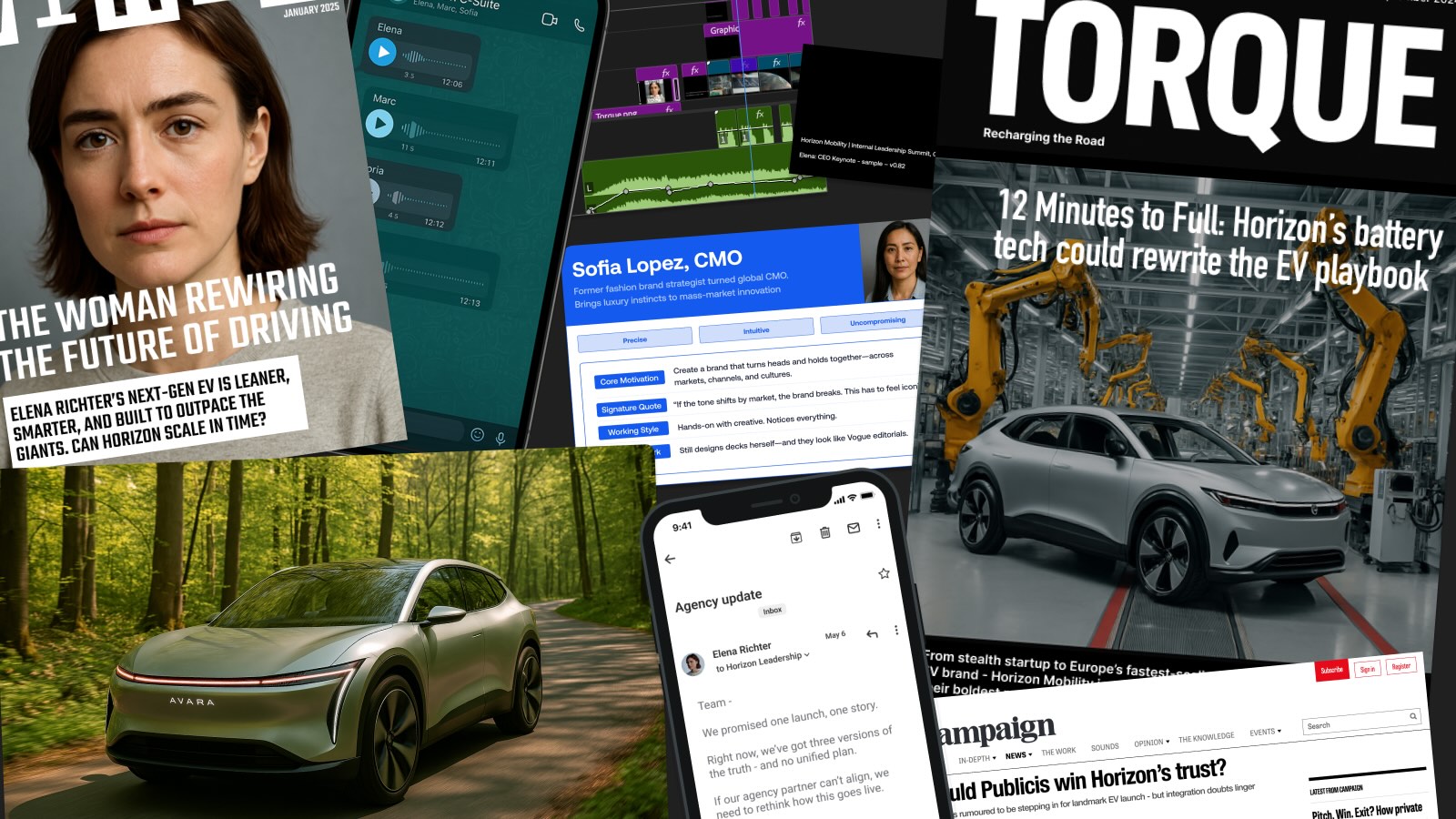
- Scenarios built like escape rooms for the mind, with complete fictional worlds, competing pressures, and no obvious right answers
- Drills designed as timed challenges with immediate feedback, including voice-note exercises where participants had to respond in the moment
- Frameworks introduced not as theory but as tools participants needed to solve the problems in front of them
Drills like "Dial It to 11" pushed participants to take safe ideas and make them genuinely memorable. The final scenario in Module 4 was rebuilt from scratch to call back concepts from earlier modules, creating spaced repetition through gameplay rather than review slides.
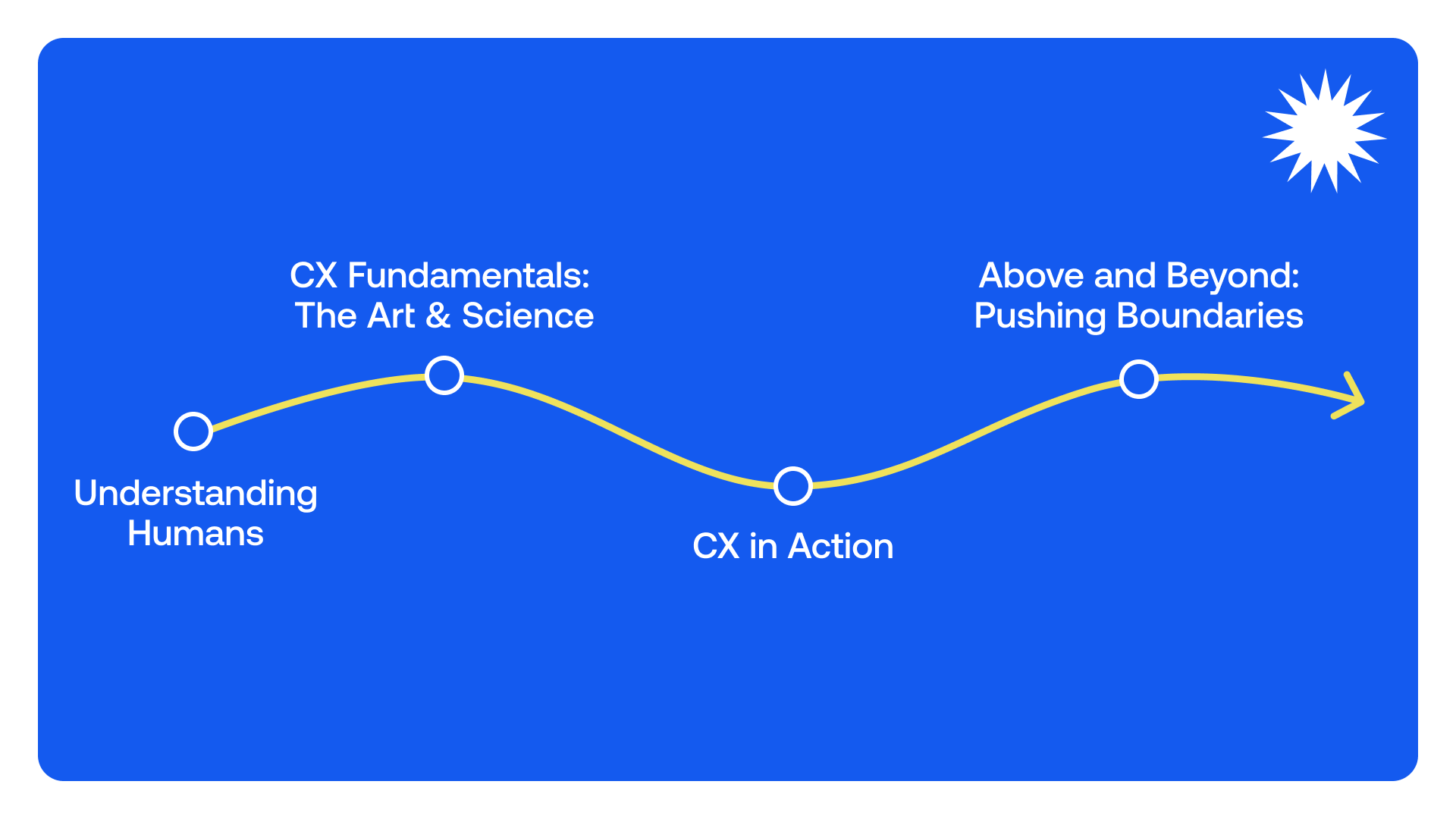
The four modules
The program moved from human fundamentals to experience architecture to live application:
Module 1: Understanding Humans
Diagnostic tools for reading people and situations. The 5 Whys for getting past surface-level answers. Social Styles (TRACOM) for adapting communication. Practice scenarios where participants had to decode what clients weren't saying out loud.
Module 2: The Art & Science of CX
Experience architecture fundamentals. The 6 Phases of Experience Design as a lens for sequencing moments. Inspiration drawn from hospitality (Will Guidara's Unreasonable Hospitality) and sensory design.
Module 3: CX in Action
Subtlety and spectacle. The Eventness framework for understanding what makes moments memorable. Format anatomy for designing repeatable experiences. References ranged from Brian Eno's generative art to Hot Ones interview prep.
Module 4: Immersion & Impact
Story science and the 7 story types. Three levels of immersion (sensory, narrative, ontological). How technology can amplify meaning rather than just add flash. The final scenario integrated frameworks from all four modules.
Each module included a resource pack with frameworks, prompts, and references participants could return to after the program.
Scaling without flattening
The harder problem was iteration at scale. Each cohort surfaced what worked and what didn't. We refined drills for greater complexity, added clearer scenario scaffolding, and introduced new frameworks like New Wine, Old Oak (reframing familiar formats with fresh twists) and Levels of Immersion based on what participants were actually struggling with.
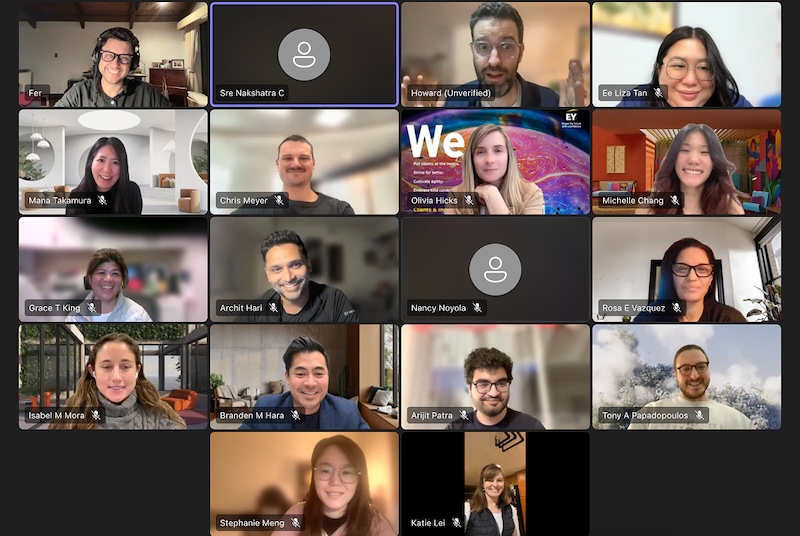
By cohorts 3 and 4, the program had evolved significantly from where it started. Participants from Denver to Hong Kong went through the same structure, but each cohort shaped what came next.
What shifted
NPS of +65 (Excellent, approaching World-Class) across cohorts 3 and 4, with an overall rating of 8.86/10.
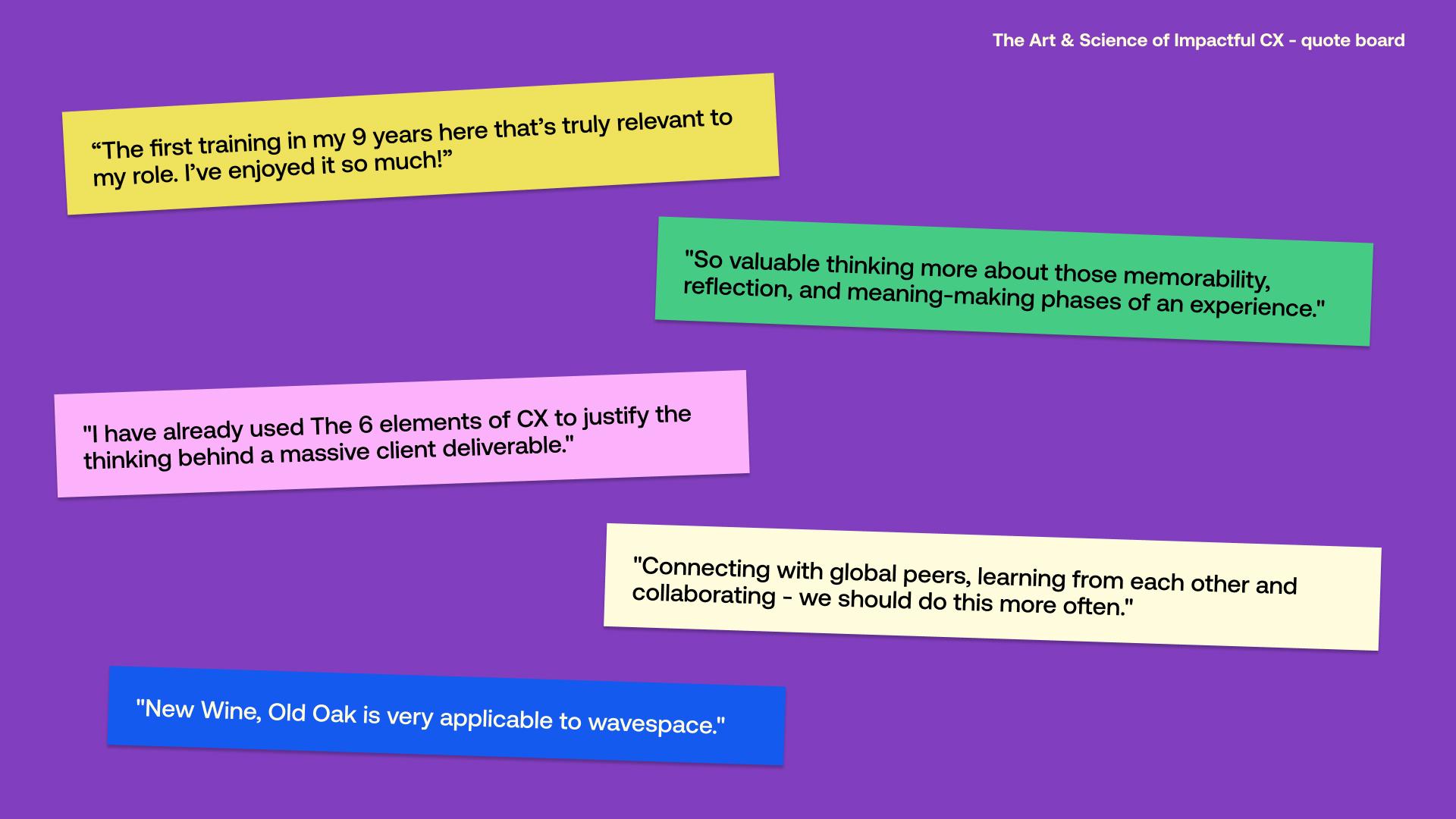
But the qualitative feedback told the fuller story. Participants consistently highlighted practical application:
"The 6 elements of CX - I have already used it to justify the thinking behind a massive client deliverable."
"Thinking more about those memorability, reflection, and meaning-making phases of an experience."
"New Wine, Old Oak is very applicable to wavespace."
Frameworks like Eventness, Journey Mapping, and Levels of Immersion gave people concrete language to talk about experience design. The global peer connections were valued as much as the content itself.
What's next
The program continues to expand:
- CX Champions Circle: Monthly facilitated salons where alumni debrief real client work and test tools together
- Cross-EY activation: Extending the content to teams beyond Wavespace, starting with discovery interviews and pop-up collaborations
Recent projects
Want to create something different?
We help pioneers turn their expertise into category-defining learning experiences.